

From Hinges to Handles: Demystifying uPVC Window Hardware and Parts
Why uPVC Window Hardware Matters More Than You Think
uPVC window hardware is the collection of mechanical components—handles, locks, hinges, and locking mechanisms—that allow your windows to open, close, and secure properly. It includes:
- Handles (Espag, Cockspur, inline, cranked)
- Locking systems (multi-point locks, shootbolts, espagnolette mechanisms)
- Hinges and stays (friction stays, butt hinges, flag hinges)
- Security components (mushroom cams, cylinders, anti-jemmy features)
- Sealing and support parts (keeps, strikers, restrictors)
These components work together to provide security, weather sealing, smooth operation, and ventilation control for your windows.
Most homeowners focus on the frame and glass when choosing windows. That's understandable—they're what you see every day. But the hardware? That's where the real magic happens.
As one comprehensive guide puts it, "An important but often overlooked aspect of uPVC products is the hardware—the hinges, handles, locks, and other fittings that allow the windows and doors to operate and secure properly."
Your window hardware is the unsung hero of your home. It's what stands between your family and a break-in. It's what keeps cold drafts out during winter storms. It's what determines whether your window will still operate smoothly after 10,000 opening cycles—or jam up after just a few years.
Modern uPVC windows can last 20 to 35 years, but only if their hardware can keep pace. Low-quality fittings fail first, leaving you with windows that won't lock properly, handles that stick, or seals that no longer keep weather out.
This guide breaks down everything you need to know about uPVC window hardware. You'll learn what each component does, how to identify quality pieces, which standards matter for security and performance, and how to maintain or replace parts when needed. Whether you're upgrading existing windows or selecting hardware for new European-style installations, you'll make informed choices that protect your investment.
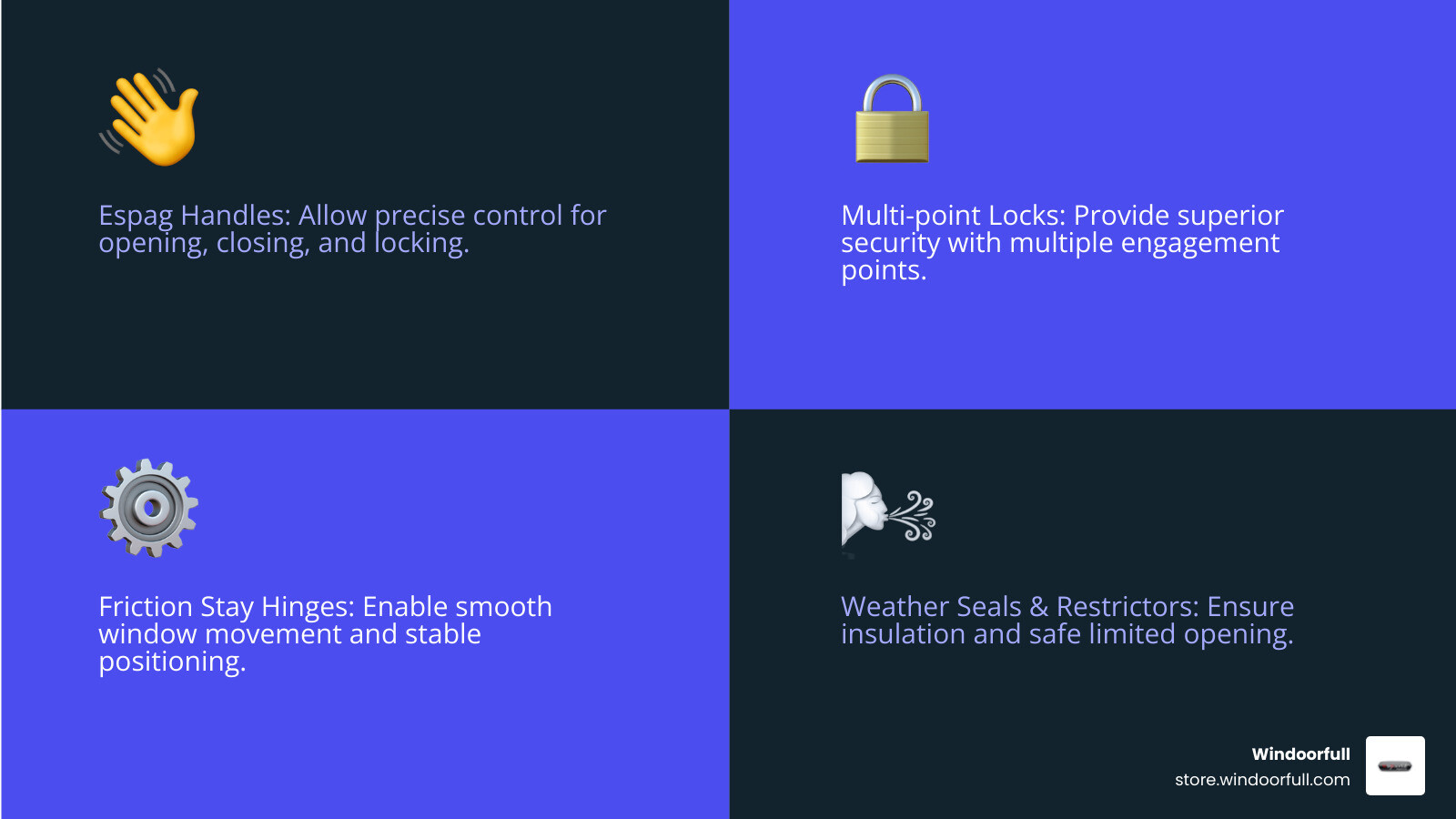
Basic uPVC window hardware vocab:
The Anatomy of a uPVC Window: Essential Hardware Components
When we talk about uPVC window hardware, we're referring to a sophisticated network of parts designed for specific functions: smooth window operation, robust security, and effective weather sealing. Each component plays a vital role in the overall performance and longevity of your windows.
Handles: The Primary Point of Contact
Handles are often the first thing we interact with on a window, making them crucial for both aesthetics and functionality. But not all handles are created equal, especially in uPVC window hardware.
- Espagnolette (Espag) Handles: These are the most common type of handle on modern uPVC windows. An Espag handle operates a multi-point locking system through a central spindle, usually 7mm square. When you turn the handle, the spindle rotates, driving a rod (the espagnolette bar) that extends along the window sash, engaging multiple locking points into the frame. This provides superior security and a tighter seal. Espag handles can be inline (straight) or cranked (offset) and often feature a key lock for added security.
- Cockspur Handles: You'll typically find cockspur handles on older uPVC or aluminum windows. Unlike Espag handles, they don't operate an internal multi-point lock. Instead, they have a distinctive "nose" or "spur" that hooks over a wedge-shaped block fixed to the window frame. To secure the window, the handle's nose simply presses against this wedge. While simpler, they offer less security than Espag systems.
- Inline and Cranked Handles: These terms describe the shape of the handle. Inline handles are straight, while cranked handles have an offset, often to provide more clearance or a different aesthetic. Both types are commonly found on Espag systems.
- Keyed Handles: Many uPVC window hardware handles come with a key lock, allowing you to secure the window in a closed or sometimes even a partially open (ventilation) position. This adds an extra layer of security and peace of mind.
Locking Mechanisms: Securing Your Home
Beyond the handle, the true security of a uPVC window lies in its internal locking mechanisms. Our European-style windows, for instance, use advanced multi-point systems.
- Multi-Point Locking Systems: These are the backbone of modern uPVC window hardware security. Instead of just one lock, multiple locking points engage around the entire window sash into the frame. This drastically increases resistance to forced entry.
- Espagnolette Locks: As mentioned, these are the bars driven by the Espag handle, featuring cams or bolts that extend into the frame.
- Shootbolt Locks: Often integrated into multi-point systems, shootbolts are solid metal bolts that extend vertically into the top and bottom of the window frame, providing robust resistance against lifting or prying.
- Mushroom Cams and Roller Cams: These are the small, mushroom-shaped or roller-shaped projections on the espagnolette bar that rotate and lock into corresponding "keeps" (strike plates) on the window frame. Mushroom cams offer a high level of security by gripping the keep, while roller cams provide a smooth closing action and compression.
- Window Cylinders: For handles that require a key, a cylinder is the component that houses the key mechanism, allowing the handle to be locked or open uped. Anti-snap cylinders offer an improved layer of security against common burglary techniques.
Hinges and Stays: The Mechanics of Movement
Hinges and stays are what allow your window to open and control its movement, ensuring both functionality and safety.
- Friction Stays: These are robust hinges that allow a window to open and stay at any desired position without additional support. They create friction to hold the sash in place, preventing it from slamming shut in the wind. We use high-quality friction stays in our European-engineered windows to ensure smooth, controlled movement.
- Butt Hinges and Flag Hinges: These are more traditional hinge types, sometimes found on uPVC casement windows or doors. Butt hinges are typically two leaves joined by a pin, while flag hinges are often adjustable and allow for easier alignment of the sash.
- Egress Hinges: These are specialized friction stays designed to allow a window to open to a wider angle (typically 90 degrees) to meet fire escape regulations, especially crucial in bedrooms.
- Window Restrictors: Essential for safety, especially in homes with children, restrictors limit how far a window can open. They can be disengaged to allow full opening for cleaning or emergencies.
Quality, Security, and Performance: Decoding uPVC Window Hardware Standards
Choosing the right uPVC window hardware isn't just about what looks good; it's about what performs best and keeps your home safe. Understanding performance grades, security ratings, and material science is key to making an informed decision.
Materials Matter: What Is Your Hardware Made Of?
The material composition of your uPVC window hardware directly impacts its durability, corrosion resistance, and overall lifespan.
- Stainless Steel: This is the champion of corrosion resistance and strength, making it ideal for high-performance hardware. "Stainless steel offers the best corrosion resistance and strength," and it's particularly recommended for areas exposed to harsh elements.
- Zinc Alloy: A common and cost-effective material, zinc alloy offers good strength and is often coated for improved corrosion resistance. It's a popular choice for many internal components and handles.
- Aluminum: Lightweight and naturally resistant to corrosion, aluminum is frequently used for handles and certain hinge components.
- Reinforced Plastic: For some less critical components or where cost is a major factor, reinforced plastic can offer "good performance at a lower price point." However, its use should be balanced with the need for strength and durability in key areas.
Hardware for Coastal Environments (Marine Grade): If you live near the coast, salt spray can rapidly corrode standard metal hardware. Marine Grade hardware, typically made from high-grade stainless steel (like 316 stainless steel), is specifically designed to resist extreme corrosion, ensuring longevity in harsh, salty air environments. Investing in Marine Grade hardware is an actionable step to protect your windows and doors in such conditions.
| Material | Durability | Cost | Corrosion Resistance | Pros | Cons |
|---|---|---|---|---|---|
| Stainless Steel | Excellent | High | Excellent | Best for strength & corrosion; ideal for coastal areas (Marine Grade) | Higher upfront cost |
| Zinc Alloy | Good | Medium | Good (when coated) | Good strength, cost-effective, versatile | Can corrode if coating is compromised |
| Aluminum | Good | Medium | Good | Lightweight, naturally corrosion-resistant, aesthetic options | Less strong than steel, can scratch |
| Reinforced Plastic | Fair | Low | Good | Cost-effective, good for non-load bearing parts | Lower strength, can degrade with UV over time |
Understanding Performance Grades and Security for uPVC Window Hardware
Performance grades are crucial indicators of how well your uPVC window hardware will stand up to daily use, environmental factors, and potential intruders.
- PAS 24:2016 Security Standard: This is a key standard in the UK for improved security performance. Hardware meeting PAS 24 requirements has undergone rigorous testing to resist common attack methods, providing homeowners with confidence in their window's security. For our USA customers, while PAS 24 is a UK standard, it represents a benchmark for the high-security features we incorporate from European engineering.
- RAL Quality Marks (e.g., RAL-GZ 607/9): RAL is a German quality assurance system. Hardware with RAL certification indicates adherence to strict quality control and performance standards for durability and functionality.
- Secured by Design: This is a police-backed initiative that focuses on crime prevention through design. Products carrying the Secured by Design accreditation have been tested to higher security standards, often exceeding minimum building regulations.
- Anti-Jemmy Features: These are design elements that make it much harder for burglars to pry open a window using a crowbar or similar tool, often involving robust interlocking mechanisms.
- Anti-Snap Cylinders: A common point of attack for burglars is the cylinder lock. Anti-snap cylinders are designed to prevent the cylinder from being snapped in half, a technique used to bypass traditional locks.
When choosing uPVC window hardware, especially for security, it's wise to "invest more in external hardware for longevity and security" and to "avoid ungraded budget lines of hardware."
The uPVC Advantage: Why This Hardware Excels
We often get asked about the benefits of uPVC window hardware compared to hardware for other window materials like aluminum or timber. The answer lies in several key advantages:
- Low Maintenance: uPVC hardware, combined with the uPVC frame, requires minimal upkeep. A simple cleaning and occasional lubrication are usually all that's needed to keep it functioning smoothly for decades. This contrasts with timber hardware, which might require more frequent painting or treatment.
- Inherent Weather Resistance: uPVC frames and their compatible hardware are designed to withstand harsh weather conditions, including extreme temperatures, heavy rain, and strong winds. This means less warping, rotting, or corrosion compared to timber or some lower-grade aluminum hardware.
- Thermal Efficiency Contribution: While the frame itself is the primary insulator, well-sealed and properly functioning hardware contributes to the overall thermal efficiency of the window. Tight-fitting locks and seals prevent drafts, enhancing the window's ability to keep your home warm in winter and cool in summer, a core benefit of our smart choices: how energy-efficient uPVC windows transform your home.
A Practical Guide to Selecting and Replacing Your Hardware
Whether you're tackling a DIY replacement or making choices for new installations, selecting and maintaining your uPVC window hardware requires a practical approach.
Matching Hardware to Your Window Style
The type of window you have dictates the appropriate hardware. Using the wrong hardware can compromise functionality, security, and even the window's lifespan.
- Casement Windows: These windows, which open outwards or inwards on hinges, typically require 2-4 hinges (often friction stays) and a compatible Espag or multi-point locking mechanism operated by a handle.
- Sliding Windows: Sliding windows need slimline handles, locks, and recessed friction stays that won't interfere with the sash's movement. Rollers and crescent locks are also common components for smooth operation and security in sliding systems.
- Tilt & Turn Windows: Our specialty at Windoorfull! These versatile European-style windows have unique hardware that allows them to both tilt inwards from the top for ventilation and swing inwards from the side for full opening and easy cleaning. This complex functionality relies on specialized multi-point locking mechanisms, hinges, and a single handle that controls all functions. For more on this, check out our ultimate guide to tilt & turn windows.
- French Doors: Similar to casement windows but larger, French doors require heavy-duty hinges, robust multi-point locking systems, and durable handles to withstand frequent use and provide secure closure for both leaves. Unlock Your Style: Finding the Right Hardware for French Doors has more details.
The benefits of our European-style hardware are clear: superior energy efficiency, improved security through multi-point locking, and versatile functionality like the tilt and turn action, all designed for the long haul.
How to Measure for Replacement Handles and Parts
Replacing a uPVC window handle or part is a common task, and getting the measurements right is crucial.
- Identifying Handle Type: First, determine if you have an Espag or Cockspur handle. An Espag handle will have a spindle extending from the back, while a Cockspur handle will have a visible "nose" that hooks onto the frame.
- Measuring Spindle Length (for Espag handles): This is critical. Measure the metal spindle's length from the base of the handle (where it meets the window frame) to its tip. Common spindle lengths include 10mm, 15mm, 20mm, 30mm, and 40mm. You can also measure the depth of the center hole in your window and round down to the nearest size available.
- Measuring Screw Hole Centers (PZ size): For Espag handles, measure the distance between the centers of the two screw holes. This is usually standard, but it's always best to check.
- Determining Handedness (Left vs. Right): Some Espag handles are "handed," meaning they are designed for either left-hand or right-hand opening windows. This refers to the direction the handle points when closed and which way it turns to lock/open up. Cockspur handles are often explicitly left or right-handed.
Step-by-step instructions for measuring a replacement Espag handle:
- Remove the existing handle: Unscrew the two visible screws on the handle's faceplate (they might be hidden under small caps).
- Measure the spindle length: Once removed, measure the square metal spindle from the base of the handle (where it would sit against the window) to the end of the spindle.
- Measure the screw hole centers: Measure the distance between the centers of the two screw holes on the handle's faceplate.
- Note the handle shape: Is it inline (straight) or cranked (offset)?
- Check for handedness: If the handle has a distinct ergonomic shape, note if it's left or right-handed. For most modern uPVC Espag handles, they are universal (inline) or can be reversed, but it's good to be aware.
Balancing Budget with Quality and Longevity
It's tempting to opt for the cheapest replacement parts, but when it comes to uPVC window hardware, balancing budget with quality is a smart long-term strategy.
- Prioritizing External Hardware: Hardware exposed to the elements (like handles and hinges on external-facing windows) should be of higher quality to resist corrosion and wear. As our research suggests, "It is advisable to invest more in external hardware for longevity and security."
- High-Traffic Areas: Windows or doors that are opened and closed frequently (e.g., a kitchen window, front door) will benefit from more robust, durable hardware. Higher-quality commercial and heavy-duty hardware offers "the best functionality, security, and lifespans but come at increased cost." This increased cost is often worth it for the extended lifespan and reduced need for repairs.
- Reputable Mid-Market Brands: While avoiding the cheapest "ungraded budget lines," you don't always need the absolute top-tier. Many mid-market brands offer excellent quality and performance at a more accessible price point.
- Long-Term Value vs. Upfront Cost: A slightly more expensive, higher-quality piece of hardware that lasts 20 years is often a better investment than a cheap one that needs replacing every few years. This aligns with the overall longevity of uPVC windows themselves, which can last 20-35 years.
Maintenance and Longevity: Keeping Your Hardware in Top Condition
Even the best uPVC window hardware needs a little love to ensure it performs optimally throughout its impressive lifespan. Proper maintenance is key to extending the life of your windows and avoiding costly repairs down the line.
Common Issues and Signs of Wear and Tear
Being aware of potential problems can help you address them before they become major headaches. Here are some signs to look out for:
- Stiff or Loose Handles: If your handle is hard to turn or feels wobbly, it could indicate a need for lubrication, adjustment, or replacement of internal components.
- Draughts or Poor Sealing: If you feel a breeze coming through a closed window, the locking mechanism might not be pulling the sash tightly against the frame. This could be due to worn keeps, misaligned cams, or a failing espagnolette bar.
- Difficulty Locking: If the window won't lock securely, it's a major security concern. This often points to issues with the multi-point locking mechanism, such as bent cams, worn gearboxes, or misalignment.
- Visible Corrosion or Rust: While uPVC hardware is generally resistant, prolonged exposure to moisture or harsh chemicals can lead to corrosion on metal parts, particularly in coastal areas if Marine Grade hardware wasn't used.
- Grinding Noises: Unusual sounds during operation can indicate friction stays or internal mechanisms that are seizing up or have damaged parts.
A Simple Maintenance Routine for Your uPVC Window Hardware
A little proactive care goes a long way in preserving your uPVC window hardware and ensuring its smooth operation for years.
- Regular Cleaning: Clean your uPVC window hardware and frames with a mild detergent and water. "Avoid abrasive cleaners that can damage the surface." This simple step prevents dirt and grime buildup from hindering movement.
- Silicone-Based Lubrication: Lubricate all moving parts—hinges, locks, and handles—with a silicone-based lubricant every six months. This is crucial for smooth operation and preventing stiffness.
- Tightening Loose Screws: Periodically check all visible screws on your handles and hinges. If any are loose, gently tighten them to ensure proper alignment and function.
- Clearing Drainage Channels: uPVC windows have small drainage holes (weep holes) at the bottom of the frame to allow water to escape. Ensure these are clear of debris to prevent water buildup, which can lead to corrosion of internal hardware.
Lifespan and Influencing Factors
The typical lifespan of uPVC window hardware is impressive, often matching the 20 to 35-year longevity of the uPVC frames themselves. However, several factors can influence this:
- Environmental Factors: Extreme weather conditions, significant temperature fluctuations, and prolonged exposure to sunlight can accelerate wear.
- UV Exposure: Over time, UV rays can degrade certain plastic components or coatings, though modern hardware is designed to resist this.
- Salty Air Impact: As discussed, coastal environments with salty air are particularly harsh on standard metal hardware, significantly reducing its lifespan if not Marine Grade.
- Frequency of Use: A window in a high-traffic area that's opened and closed multiple times a day will naturally experience more wear than a rarely used one.
- Quality of Installation: Proper installation is paramount. Hardware that is correctly aligned and fitted will last much longer than poorly installed components.
Frequently Asked Questions about uPVC Window Hardware
How do I know if I have an Espag or Cockspur handle?
An Espag handle operates a locking mechanism inside the window with a square metal spindle, and you won't see a part that hooks onto the frame. A Cockspur handle has a visible "nose" or spur that closes over a wedge on the window frame itself.
Can I replace a uPVC window handle myself?
Yes, replacing a uPVC window handle is a common DIY task. It typically involves removing two screws, swapping the old handle for a new one with the correct spindle length and screw centers, and securing the new handle.
What does "handedness" mean for window handles?
Handedness refers to the side of the window the handle is on and the direction it points. For a casement window, a right-handed handle is on the right side of the sash and typically points left when closed, opening the window to the right.
Conclusion
We've journeyed from the foundational components of uPVC window hardware to the critical details of quality, security, and maintenance. It's clear that these unsung heroes play a pivotal role in the security, functionality, and energy efficiency of your home. By understanding the different types of hardware, the materials they're made from, and the performance standards that define their quality, you're empowered to make informed choices.
Whether you're replacing a worn-out handle or selecting hardware for new European-engineered windows, prioritizing quality and proper maintenance ensures your investment lasts for decades. At Windoorfull, we're dedicated to bringing you authentic European engineering directly to USA homes, offering superior energy efficiency and versatile functionality, backed by robust hardware.
Ready to explore how premium uPVC window hardware can improve your home? Explore your home window upgrade options today.